DESIGN TECHNOLOGY
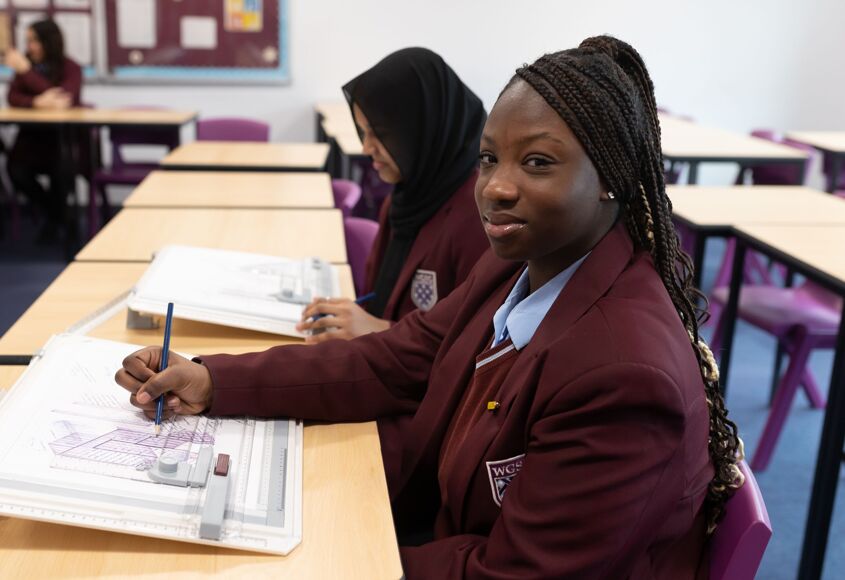
Department vision
Design and Technology is an inspiring, rigorous, and practical subject. Using creativity and imagination, students design and make products that solve real and relevant problems within a variety of contexts. Students learn how to take risks, becoming resourceful, innovative, enterprising, and capable citizens. Through the evaluation of past and present design and technology, they develop a critical understanding of its impact on daily life and the wider world. High-quality design and technology education makes an essential contribution to the creativity, culture, wealth, and wellbeing of the nation.
Year 7
| Topic | Learning Outcomes | |
| Curriculum Focus for the Year | Skills and Safety | In Year 7, students develop core practical skills across Food, Design & Technology, and Textiles. They build confidence, creativity, and independence while learning to work safely and responsibly. Students develop essential practical skills by learning to use tools, equipment, and materials safely across the kitchen, workshop, and textiles room. They follow clear health and safety procedures, understand the importance of hygiene, PPE, and risk awareness, and apply safe handling techniques—especially with high-risk foods and sharp tools. Through hands-on activities, they build confidence in measuring, cutting, joining, and finishing, while exploring design communication, food safety, and textile techniques. These experiences lay the groundwork for independent, responsible learning in future years. |
| Term 1-5 (taught on rotation) | Design Dimensions: from concept to creation. | Understand and apply the principles of oblique drawing to represent 3D objects. Develop accuracy in creating isometric drawings to represent 3D forms. Learn how to draw objects using 2-point perspective to create realistic depth. Explore effective ways to present information visually and verbally. Investigate the work of a designer and understand their influence on design. Analyse existing tea packaging to understand design choices and user appeal. Begin designing tea packaging with a focus on branding and user needs. Create accurate nets for 3D packaging prototypes. Construct a physical prototype of tea packaging using a designed net. To demonstrate understanding of key concepts and skills covered in previous lessons through a formal assessment. Learn and apply basic modelling techniques using appropriate materials. Create a scale model using learned modelling techniques. Understand biomimicry and begin responding to a design brief. Begin designing a biomimicry-inspired design solution Develop and refine design through sketching and modelling. |
| Textiles | To explain the importance of H&S in the textiles workshop Workroom procedures & risk assessment Correct tools selection and use To explore the origins of fibres and their working properties Hand embroidery techniques To develop a design for pattern making To apply drawing and rendering skills to produce ideas with detailed annotation To understand how to use peer feedback to develop a final solution To follow the correct sequence of making To analyse your project using critical thinking skills | |
| Health, Safety and Hygiene & Food Safety Hygiene | To explain the principles of the 4C’s Cooking – Key Temperatures Chilling – Key Temperatures and Storage of food Cleaning – Washing up and cleaning self and equipment Cross Contamination – Safe workspaces and clearing away To apply and independently demonstrate the principles of the 4C’s To explore food bacteria. To apply food safe handling of high-risk foods. To apply accurate knife skills to a challenge task To practice using electrical equipment. To identify key allergens in food products. To demonstrate the safe handling of chicken. To demonstrate the application of 4C’s when handling high risk food independently. | |
| Term 6 | Design In Practice 1 | Students will develop practical skills by exploring fabric properties and applying manipulation techniques to create textile items. Students will apply design principles to develop original, functional, and visually effective solutions across a range of design contexts. Students will design creative and appealing dishes using presentation methods that reflect professional standards. Students will build practical cooking skills by using a variety of techniques and working safely with ingredients. |
Year 8
| Topic | Learning Outcomes | |
| Curriculum Focus for the Year | Sustainability and the Environment | In Year 8, students deepen their understanding of sustainability and the environment through practical, project-based learning across Food, Design & Technology, and Textiles. In food technology, they explore food provenance, origins, and the impact of food choices on the planet. In design and technology, students engage in an architectural modelling project, applying knowledge of sustainable use of materials, construction methods, and environmentally conscious design choices. In textiles, they investigate the environmental effects of fabric production and consider ethical sourcing and responsible material use. These projects help students develop practical skills, critical thinking, and a strong awareness of how design and technology influence the world around them. |
| Term 1 – 5 (taught on rotation) | Food Provenence: Origins | To explore where food comes from. To identify how farming impacts the environment To demonstrate safe use of shortening a pastry dough To create a dish using seasonal foods To investigate farming methods To identify the method of farming for the ingredients in a dish To identify the farming methods used within a dish To analyse the impact of fair trade on food sustainability To practice dovetailing two recipes To use a fair-trade ingredient in a dish. To promote the reduction of food waste. To identify the secondary processing used in making pasta. To demonstrate safe use of a pasta machine. To explain the importance of blind baking. To demonstrate safe use of baking beads within a practical. To design a dish to reduce food waste |
| Textiles | To identify a target market To analyse a brief Practical sewing skills using machine Research a theme Design skills & development Construction skills Evaluation of practical Product Lifecycle Sustainability in textiles | |
| Architectural Design Modelling | Define sustainability in the context of construction and describe the key features of garden villages. Conduct research into a known architectural structure and summarise its design, purpose, and sustainable features. Identify a range of sustainable building materials and explain their environmental advantages over traditional options. Collaborate to select a known architectural structure and begin planning a scaled model based on accurate measurements. Explain the financial, cultural, and social benefits of sustainable construction methods in modern architecture. Develop a detailed plan for constructing a scaled model, including materials, tools, roles, and time management. Demonstrate safe and accurate use of tools and equipment to prepare materials for model construction. Begin constructing the architectural model, applying design plans and sustainable principles. Continue model construction, refining techniques and addressing design or structural challenges. Apply problem-solving and teamwork to progress the model build with increasing accuracy and detail. Complete the main structure of the model, ensuring alignment with the original design and sustainability goals. Finalise the model with finishing details and sustainable features, ready for presentation. Demonstrate knowledge and understanding of sustainable construction, materials, and architectural design through assessment. Critically evaluate the completed model and group performance, identifying strengths and areas for improvement. Present the final model to an audience, clearly explaining design decisions, sustainability features, and construction methods. | |
| Term 6 | Design In Practice 2 | Students will explore the importance of herbs and spices in global cuisines, identifying key ingredients and their cultural origins. Students will investigate the health benefits of herbs and spices and develop a culturally inspired recipe that incorporates them effectively. Students will develop practical skills by exploring fabric properties and applying manipulation techniques to create textile items. Students will apply design principles to develop original, functional, and visually effective solutions across a range of design contexts. |
Year 9
| Topic | Learning Outcomes | |
| Curriculum Focus for the Year | Applied Science | In Year 9, students explore the theme of Applied Science through practical, real-world projects that prepare them for GCSE pathways in Food & Nutrition and Construction & the Built Environment. In Food & Nutrition, students investigate the science behind ingredients, nutrition, and food preparation techniques, developing a deeper understanding of how food choices affect health and performance. In the Construction & Design strand, students apply scientific and technical knowledge to design two sustainable architectural projects: a Green Hub Café and a Visitor Centre Pavilion. These projects focus on structural systems, sustainable materials, and digital planning using industry-standard software such as Revit. The curriculum promotes scientific thinking, problem-solving, and technical accuracy, while reinforcing safe working practices and independent learning. This year serves as a bridge between foundational skills and specialised study, helping students make informed decisions about future learning and careers. |
| Term 1-5 (taught on rotation) | Food Nutrition and Food Science | To analyse the eat well guide and apply information to a brief. To design a dish that meets the eat well guide and 8 tips for healthy eating guidelines and justify its contents. To write a time-plan for own dish and reflect on its effectiveness To use a multi-step recipe with shaping skill. To reflect on use of time-plan To independently create own dish that applies to brief chosen To analyse the functional properties of fats To examine how fats impact the body To analyse the functional properties of proteins To examine how proteins impact the body. To analyse the functional properties of carbohydrates To examine how carbohydrates impact the body. To analyse micronutrients To examine micronutrients, impact the body To investigate how chemical raising agents, work. To analyse chemical raising agents, experiment results To demonstrate knowledge of chemical raising agents in baked goods. To investigate how biological raising agents, work. To analyse biological raising agents, experiment results To demonstrate knowledge of biological raising agents in baked goods. |
| Construction and the Built Environment: The Green Hub Cafe, Nature Nest Pavilion | To analyse a client’s situation To interpret maps to advise client on potential planning concerns To explain the function of building elements To explore foundation types To assess the suitability of building structure type To recommend material use based on U-Values To analyse different types of sustainable technologies To identify and calculate information required for construction projects To apply calculated information into creating a floor plan proposal To draw 2D plans of a construction design To draw elevations of a construction design To enhance designs with additional features to meet client’s needs To present 3D plans of the design proposal using REVIT | |
| Term 6 | Structural Design Challenge & Food Mini NEA | Structural Design Challenge: To interpret a design brief and develop creative ideas that reflect the identity and values of the local community. To apply safe and effective use of tools and materials when creating physical and digital models, including the use of Revit for site planning. To evaluate design ideas based on sustainability, safety, aesthetic appeal, and feasibility. To communicate design concepts clearly through annotated drawings, mood boards, and 3D models. Mini Food NEA: To understand nutritional needs for different age groups Prepare a dish to suit the needs of different age groups |
Years 10 & 11 – Food Preparation and Nutrition
Year 10
In Years 10 and 11, students explore a wide range of topics in Food Preparation and Nutrition, building both theoretical knowledge and practical skills. The course begins with a deep dive into nutrients and their role in health, followed by the science behind cooking methods and food preparation. Students then apply this knowledge to meet the nutritional needs of different groups and understand the impact of diet on health. As the year progresses, they investigate food safety, food choice, and the environmental impact of food production. In Year 11, the focus shifts to completing two major non-exam assessments (NEA 1 and NEA 2), where students investigate ingredients and prepare a three-dish menu. The year concludes with revision and exam preparation, covering all key areas including nutrition, food science, safety, choice, and provenance.
| Topic | Learning Outcomes | |
Term 1 | Nutrient | Nutrients to be studies are Proteins, Fats, Carbohydrates, Minerals, Vitamins and Water For each nutrient, students will: Define the nutrient Explain the functions of the nutrient in the body Identify the main sources of the nutrient Describe the effects of a deficiency or an excess of the nutrient in the diet Calculate the amount of the nutrient needed every day for different life stages |
| Term 2 | Food Science and NEA 1 Practice | The purpose and function of cooking food, students will: Explain why food is cooking Categorise the methods of transferring heat to food Describe the different methods of cooking Evaluate the impact of cooking methods on food Discuss how to prepare and cook fruits and vegetables whilst conserving nutritional value. The scientific principles underlying processes used to prepare and cook foods and the working characteristics, function and chemical properties of the following: Proteins Carbohydrates Fats and Oils Raising Agents Fruits and Vegetables |
| Term 3 | Nutritional Needs and Health and NEA 2 Practice | Students will need to apply their nutrient knowledge to: Evaluate the nutritional needs of people at different life stages and with special dietary requirements (e.g. allergies) Explain what is meant by a healthy, balanced diet Demonstrate how to choose and interesting and varied diet Define energy, its function in the body, identify its source, describe the effects of a deficiency or an excess of energy and calculate the amount of energy needed every day for different life stages Conduct a nutritional analysis in order to plan and modify recipes to reflect a healthy diet Examine the relationship between diet, nutrition and health Describe major diet-related diseases and the risk factors for each disease |
Term 4 | PPE and Food Safety | The safety of food that is studied includes the principles of food safety as well as food spoilage and contamination. Students will: Evaluate the impact that micro-organisms and enzymes have on food and how this affects safety Recognise the signs of food spoilage Explain how micro-organisms are used in the production of different food products Discover how bacterial contamination can occur and the impact this has on safety Advise on safe purchasing and storing of food Apply food safety principles to preparing, cooking and serving food |
Term 5 | Food Choice | Food choice is influenced by a huge variety of factors. Student will: Explain the factors that influence food choice Evaluate food choice relating to religion, culture, ethical and moral beliefs and medication conditions Determine how information about food is displayed for the consumer Investigate British and international cuisine, looking at the distinctive features, cooking methods, eating patterns, presentation styles and traditional recipes Conduct sensory analysis evaluations |
Term 6 | Food Provenance | The environmental impact and sustainability of food. Students will; Identify wheat and how ingredients are grown, gathered, reared and caught Discuss the advantages and disadvantages of organic farming, genetically modified foods and seasonal foods Evaluate the environmental issues associated with food Investigate the carbon footprint of food, the reasons for buying locally and the impact of food waste on the environment Define food sustainability through studying food security, sustainable food production and fair trade Food is processed and put into various methods of production before it can be sold and consumed. Students will Explain the primary and secondary stages of food processing and production Evaluate the impact of processing on sensory and nutritional properties of ingredients Examine the purpose of food production with associated better health implications, such as fortification, use of additives and nutritional modification |
Year 11
| Topic | Learning Outcomes | |
| Term 1 | NEA 1 – Food Investigation (15% of GCSE) | An investigation into the working characteristics and the functional and chemical properties of a particular ingredient through practical investigation. Students will produce a report which will include research into ‘how ingredients work and why’. Section A: Research (6 Marks) Section B: Investigation (15 Marks) Section C: Analysis and Investigation (9 Marks) |
| Term 2 | NEA 2 – Food Preparation Assessment (35%) | A report demonstrating preparation, cooking and presentation of a final menu with three dishes to meet the needs of a specific context. Section A: Research (6 Marks) Section B: Technical Skills (18 Marks) Demonstrate technical skills in the preparation and cooking of four dishes Select and use equipment for different skills with food safety principles applied Identify the technical skills within each dish PPE – Two weeks of PPE |
| Term 3 | NEA 2 – Food Preparation Assessment (35%) | Section C: Planning for the Final Menu (8 Marks) Justify the chosen dishes for the final menu linked to the context, Write a detailed dovetailed time plan with food safety principles demonstrated Section D: Making Final Dish (30 Marks) 3 Hour Practical NEA with all three dishes cooked. Section E: Analysis of Dishes (8 Marks) Record and analyse sensory properties Carry out nutritional analysis of dishes Analyse the cost of the three dishes |
| Term 4 | Revision and Exam Preparation | Food, Nutrition and Health – Nutrients Nutrients to be studies are Proteins, Fats, Carbohydrates, Minerals, Vitamins and Water For each nutrient, students will: Define the nutrient Explain the functions of the nutrient in the body Identify the main sources of the nutrient Describe the effects of a deficiency or an excess of the nutrient in the diet Calculate the amount of the nutrient needed every day for different life stages Food Science The scientific principles underlying processes used to prepare and cook foods and the working characteristics, function and chemical properties of the following: Proteins, Carbohydrates, Fats and Oils, Raising Agents and Fruits and Vegetables |
| Term 5 | Revision and Exam Preparation | Food Safety The safety of food that is studied includes the principles of food safety as well as food spoilage and contamination. Food Choice Food choice is influenced by a huge variety of factors. Food Provenance The environmental impact and sustainability of food. Examine the purpose of food production with associated better health implications, such as fortification, use of additives and nutritional modification |
| Term 6 |
Years 10 & 11 – Construction and the Built Environment
Year 10
Over Years 10 and 11, students studying the Built Environment develop a strong foundation in construction, design, and sustainability through both theoretical learning and hands-on project work. The course introduces students to buildings, structures, and construction technologies, while developing key skills in drafting, modelling, and evaluation. A major focus is placed on using industry-standard software such as Autodesk Revit, which is widely used by architects and construction professionals to create accurate 2D plans and 3D models. Students explore sustainable construction methods, the lifecycle of the built environment, and the impact of design decisions. In Year 11, they complete controlled assessment coursework, applying their knowledge of health and safety, calculations, and design evaluation, before concluding the course with focused exam preparation.
| Topic | Learning Outcomes | |
| Term 1 | Introduction to course, buildings and structures, technologies and construction. Skills development for coursework. | Unit 1: 1.3 – Types of building and structure 1.4 – Technologies and Materials Unit 2: Skills development for NEA tasks Task 1: Write a report that identifies project success 2.2 – Writing and setting success criteria Task 2: Develop 2D plans for the proposed building 2.3 – Drawing plans 2.4 – Drawing elevations 2.5 – Using the language of drafting 2.6 – Drawing two dimensional (2D) plans Task 3: Develop a 3D model of the proposed building 2.7 – Creating three dimensional (3D) virtual models and plans Task 5: Evaluate the 2D, 3D and building design against the needs of the end users 2.8 – Evaluating design tasks |
| Term 2 | Sustainable construction methods. Design Brief identification of needs and 2D design response. | Unit 1: 1.6 – Sustainable construction methods Unit 2: Mock NEA Design Brief: Task 1: Write a report that identifies project success 2.1 – Identifying and calculating information 2.2 – Writing and setting success criteria Task 2: Develop 2D plans for the proposed building 2.3 – Drawing plans 2.4 – Drawing elevations 2.5 – Using the language of drafting 2.6 – Drawing two dimensional (2D) plans |
| Term 3 | Built environment lifecycle and 2D development drawings | Unit 1: 1.2 – The built environment life cycle Unit 2: Mock NEA Design Brief: Task 2: Develop 2D plans for the proposed building 2.3 – Drawing plans 2.4 – Drawing elevations 2.5 – Using the language of drafting 2.6 – Drawing two dimensional (2D) plans |
| Term 4 | The Sector, 3D visualisations, informed calculations and evaluations. | Unit 1: 1.1 – The Sector Unit 2: Mock NEA Design Brief: Task 3: Develop a 3D model of the proposed building 2.7 – Creating three dimensional (3D) virtual models and plans Task 4: Calculations to inform design 2.1 – Identifying and calculating information Task 5: Evaluate the 2D, 3D and building design against the needs of the end users 2.8 – Evaluating design tasks |
| Term 5 | Building structures & calculations and evaluations | Unit 1: 1.5 – Building structures and forms Unit 2: Mock NEA Design Brief: Task 1: Write a report that identifies project success 2.1 – Identifying and calculating information Task 5: Evaluate the 2D, 3D and building design against the needs of the end users 2.8 – Evaluating design tasks |
| Term 6 | Trades, employments and careers. Controlled Assessment Coursework. | Unit 1: 1.7 – Trades, employment, and careers Unit 2: Controlled Assessment Analysis of the controlled assessment task set by the exam board Term 6 will include 6 hours of controlled assessment time for Unit 2 – this will be over 4 double periods Covering areas of content: 2.1 Identifying and calculating information 2.2 Writing and setting success criteria 2.3 Drawing plans |
Year 11
| Topic | Learning Outcomes | |
| Term 1 | Review and recall of core theory. Controlled Assessment Coursework | Unit 1: 1.1-1.7 1.1 – The Sector 1.2 – The built environment life cycle 1.3 – Types of building and structure 1.4 – Technologies and Materials 1.5 – Building structures and forms 1.6 – Sustainable construction methods 1.7 – Trades, employment, and careers Unit 2: Controlled Assessment: Task 2: Develop 2D plans for the proposed building 2.3 – Drawing plans 2.4 – Drawing elevations 2.5 – Using the language of drafting 2.6 – Drawing two dimensional (2D) plans |
| Term 2 | Health and safety. Controlled Assessment Coursework | Unit 1: 1.8 – Health & Safety Unit 2: Controlled Assessment: Task 3: Develop a 3D model of the proposed building 2.7 – Creating three dimensional (3D) virtual models and plan |
| Term 3 | Health and safety. Controlled Assessment Coursework | Unit 1: 1.8 – Health & Safety Unit 2: Controlled Assessment: Task 3: Develop a 3D model of the proposed building 2.7 – Creating three dimensional (3D) virtual models and plans Task 4: Calculations to inform design 2.1 – Identifying and calculating information |
| Term 4 | Exam preparation and Controlled Assessment Coursework Submission. | Unit 1: 1.1-1.8 Exam preparation Unit 2: Controlled Assessment: Task 5: Evaluate the 2D, 3D and building design against the needs of the end users Unit 1: 1.1-1.8 Exam preparation 2.8 – Evaluating design tasks |
| Term 5 | Exam Preparation | Unit 1: 1.1-1.8 Exam preparation |
| Term 6 |
Professional Construction Practice – WG6 Post 16
Year 12
| Topic | Learning Outcomes | |
| Term 1 & 2 | Unit 1 | LO1 Understand the various stages of the design process and the principals involved in taking a design through the complete design cycle LO2 Understand the purpose of the planning process and the various stages of the planning application process; and be able to evaluate the important factors that affect planning decisions NEA |
| Term 3 & 4 | Unit 1 | LO3 Understand the main health, safety and environmental factors influencing the design of the built environment LO4 Understand the provision of primary services utilities to the design of buildings in terms of the main features and basic operating principles NEA |
| Term 5 & 6 | Unit 1 | NEA (20 hours in total) |
| Term 1 & 2 | Unit 2 | LO1 Understand the main job roles and their relationship to each other within the built environment and explore typical career pathways, qualifications, and progression LO2 Be able to identify and evaluate the construction processes required to construct the sub and superstructures of a range of buildings, including finishes and services LO3 Be able to identify and evaluate a range of project management tools and techniques |
| Term 3 & 4 | Unit 2 | LO4 Be able to identify and evaluate a range of quality assurance and project monitoring processes LO5 Be able to identify and evaluate the health, safety and environmental factors influencing the creation of the built environment LO6 Be able to compare existing and developing processes used in the creation of the built environment and evaluate their impact |
| Term 5 & 6 | Unit 2 | Revision and preparation using past papersMock Examination External Exam in June |
Year 13
| Topic | Learning Outcomes | |
| Term 1 – 4 | Unit 4 | LO1 Be able to understand the basic principles and benefits of BIM within the context of the built environment LO2 Be able to understand the UK BIM Maturity Levels and use of COBie for information exchange LO3 Be able to produce basic BIM information for a building project and create information exchanges LO4 Be able to understand the relevance of the UK standards to be used and reviewed when working on a BIM project LO5 Be able to describe the basic terminology in relation to BIM, including roles, technology and processes of a BIM ProjectUnit 4 NEA (40 hours in total) |
| Term 1 -5 | Unit 3 | LO1 Be able to describe and evaluate ways of engaging stakeholders and communities, in the development and use of the built environment and the local infrastructure including transport LO2 Be able to identify ways of protecting and maintaining the environment during use of the built environment LO3 Be able to identify and evaluate ways of protecting the physical structure of the built environment LO4 Be able to examine the basic principles of soft landings and how post occupancy evaluation can ensure the soft landings approach was considered and developedPractice examination papersExternal exam in June |
Related Careers
It is widely noted that the skills learned in Design Technology across the key stages are all highly regarded skills in many careers. The creative arts industry is one of the fastest growing in the country and contributes over £75 billion to the economy, meaning that there are a huge range of careers both at home and abroad that offer a rewarding experience and healthy salary.
https://www.gov.uk/government/news/creative-industries-worth-8million-an-hour-to-uk-economy
- Designer (Fashion, jewellery, product, web, digital and many more)
- Graphic Designer/advertising executive
- Architect
- Landscape/environmental architect
- Engineer
- Food technologist
- Buyer
- Design Journalist
- Interior designer
- Surface designer (wallpaper, fabric etc)
- Model maker/propmaker
- Set Designer (film, TV, theatre)
- Costume designer